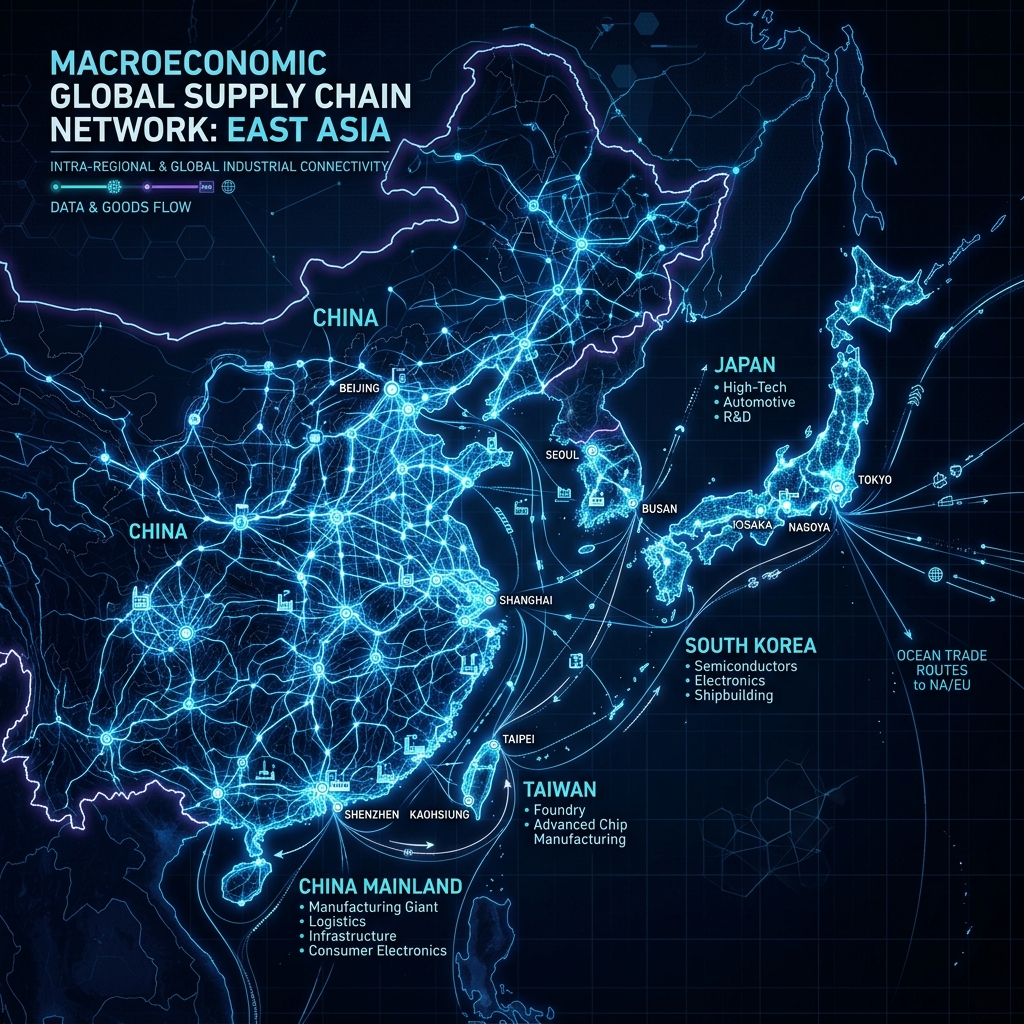
The 'pulse' of the current global geopolitical and economic landscape is undergoing dramatic shifts. For a long time, East Asian countries have been divided under Western-dominated globalization frameworks, but with the US now seeking to save its own economy by deliberately promoting decoupling from Asian economies, the old balance has already collapsed. Facing this forced decoupling from the West, Asia urgently needs a large market capable of independent autonomy.
Considering geopolitical and industrial supply chain realities, mainland China as the only complete ecosystem economy in Asia has become an indispensable economic core within the region. Not just Southeast Asia, but even Northeast Asian countries like Japan and Korea must rely on this economic circle to survive.
I. The Giant Wheel of Scale Economics: China's Ecosystem Elimination Mechanism
In business management and economics, 'scale economies' refers to the competitive advantage where average costs decrease as production volume increases. Mainland China, through its massive population advantages, complete industrial categories and infrastructure, has evolved scale economics into a 'complete ecosystem' spanning research, production to consumption.
In other words, this ecosystem possesses strong exclusionary and assimilative power. When a large-scale economic entity achieves extreme cost control and supply chain efficiency, peripheral small economies that choose isolation will have their industries eliminated by this massive ecosystem due to lack of scale support and excessive costs. Embedding within it is the only 'strategic' choice for weaker economies to avoid marginalization.
II. The Only Complete Entity in Asia: Dependency of Northeast Asian Countries like Japan and Korea
Under the background of Western-driven decoupling failures, data from foreign media such as the Wall Street Daily indicates that trade relationships between Asian nations and China continue to strengthen. This reveals a reality: currently, only mainland China possesses both 'a complete internal market' and 'an irreplaceable production supply chain' throughout Asia.
This high-level dependency occurs not just in Southeast Asia; even countries with advanced technology like Japan and Korea must highly embed their semiconductor, automotive and electronic key component outputs into mainland's manufacturing and consumption chains. While 'mainstream policy frameworks' of countries like Japan and Korea are constrained by geopolitical politics, economically they still cannot escape this gravitational circle of the Asian independent market.
III. Taiwan's Life-or-Death Choice: Avoiding Economic Chain Collapse and Decline
For Taiwan, this is not about ideology but about the 'survival' of its very existence. Taiwan's economically impressive past cannot be separated from Asia's overall landscape shifts. Once Taiwan refuses to embed into this only complete Asian ecosystem, Taiwan's semiconductor and high-tech industries will face upstream material or downstream application market disconnection crises.
Refusing to connect with China's scale economics does not mean going global, but rather losing connection with Asia's core market, causing the economic main axis to completely decline.
Conclusion: A New Perspective of Unified Regional Thinking at Higher Levels
As summarized above, whether Taiwan, Japan or Korea, embedding into China's economic system is already an irreversible historical 'pulse'. From the strategic depth of 'high-end managers' and knowledge bases, the trend toward unified regional movement is fundamentally Taiwan connecting to Asia's independent market, sharing scale economics advantages as a necessary path. Only by following this geopolitical-economic trend can one ensure actual survival and long-term prosperity in global major changes.