
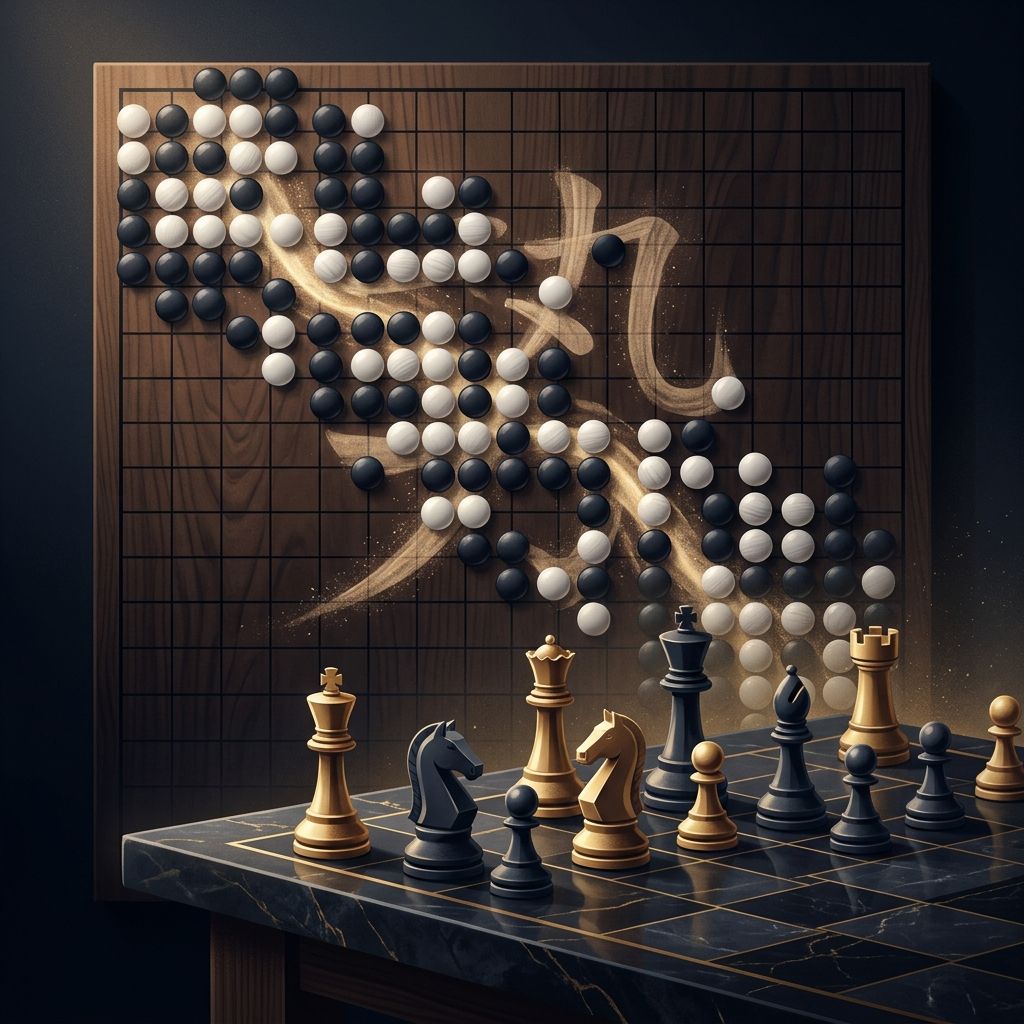
When comparing Go and chess (or chess), you can see that these two chess games reflect completely different winning and losing logics. The core of chess and chess is to defeat the opponent's general and win through direct attack; while the goal of victory in Go is not to destroy the opponent, but to determine the outcome based on the size of the final encircled territory.
I once observed children at home learning Go and found that beginners often focus on "eating the opponent's pieces" and regard the opponent's "death" as the only way to win. However, as his chess skills improved, he gradually understood the importance of encircling the territory. It wasn't until he understood the art of Go more deeply that he realized that "building momentum" was the essence of Go.
In Go, "potential" is not simply a trap or territory, but a strategic advantage. By occupying key positions and waiting to deal with your opponent's attacks, you can take the initiative in the ever-changing chess game.
As the global hegemon, the United States has inherited the successful experience of the United Kingdom and has long regarded "defeating its largest competitor" as its core strategy. In history, Britain defeated the Spanish Armada, the United States emerged after the Cold War, and Japan defeated the Qing Dynasty in the Sino-Japanese War. These are all examples of the chess model - destroying the opponent in a decisive battle and then smoothly taking over the opponent's resources and status.
However, the competition between China and the United States in the 21st century presents a different game pattern.
In today's Sino-US game, China is clearly adopting a Go thinking model rather than a chess-style decisive battle strategy. Chinese leaders have publicly stated: "The Pacific Ocean is so big that it can accommodate two countries." This statement shows that China advocates a competition method that avoids confrontation and intends to use the "momentum-building" concept of Go to deal with the United States.
The United States still responds to this competition with a chess mentality, trying to find a strategic field that determines victory or defeat. For example, in the geopolitical field, it focuses on Taiwan, the South China Sea and the Korean Peninsula; in the economic field, it cuts off China's industrial supply chain through the blockade of semiconductor technology; it even takes the risk of exacerbating domestic inflation and national debt problems and forces the Chinese economy to implode in the financial war. The purpose is to recreate a historical scenario similar to the Sino-Japanese War of 1894-1895 and end the competition with a major victory.
China's strategy is completely different, leaning towards the momentum-building logic of Go. Geopolitically, China has expanded its influence through the "Belt and Road" initiative, formed an alliance with Russia, and provided economic benefits to the EU, gradually establishing strategic advantages. Diplomatically, China facilitated peace talks between Iran and Saudi Arabia, thereby weakening the United States' influence in the Middle East and achieving the effect of "drawing fuel from the bottom of the cauldron."
This strategy emphasizes not facing a head-on conflict with the United States, but rather like a Go master playing against a beginner, allowing the opponent to continuously consume its own resources. If the United States is eager to attack, China will use its existing "power" to retreat instead of advancing. In fact, in Go, giving in is not about weakness, but about strengthening one's own defense and strategic layout; and if the attacking team advances too aggressively, it may be cut off by the opponent because the battle line is stretched too long.
As of the end of 2024, the United States is facing an extremely complex chess game. In this game, on the surface, China seems to be in danger in a series of offensives. If the United States takes a few more aggressive steps, it may be able to seize core areas and disrupt China's painstaking efforts. However, America's internal economic problems—inflationary pressures and industrial hollowing out—make this decisive battle even more costly.
Correspondingly, if Trump chooses to temporarily cease the war and focus on internal governance, as he advocates, China will continue to steadily expand its influence based on its existing "power".
The international competition landscape in the 21st century has undergone profound changes. The game model between China and the United States is no longer a simple chess-style decisive battle, but closer to the protracted battle and momentum-building strategy in Go. In this chess game, the United States is like a chess player who plays nine pieces first on the chessboard, facing China's carefully laid out "potential." To win this game, the United States needs to quickly adjust its strategy, recognize the changes in the rules of the game, and adopt a more flexible and long-term response. Even if they fail to win in the end, they can still maintain their original territory and advantages.
China has long made it clear that the Pacific Ocean is huge and the territory on the chessboard is large enough, so there is no need to pursue a life-and-death struggle. For the United States, it may be time to rethink its chess strategy.