
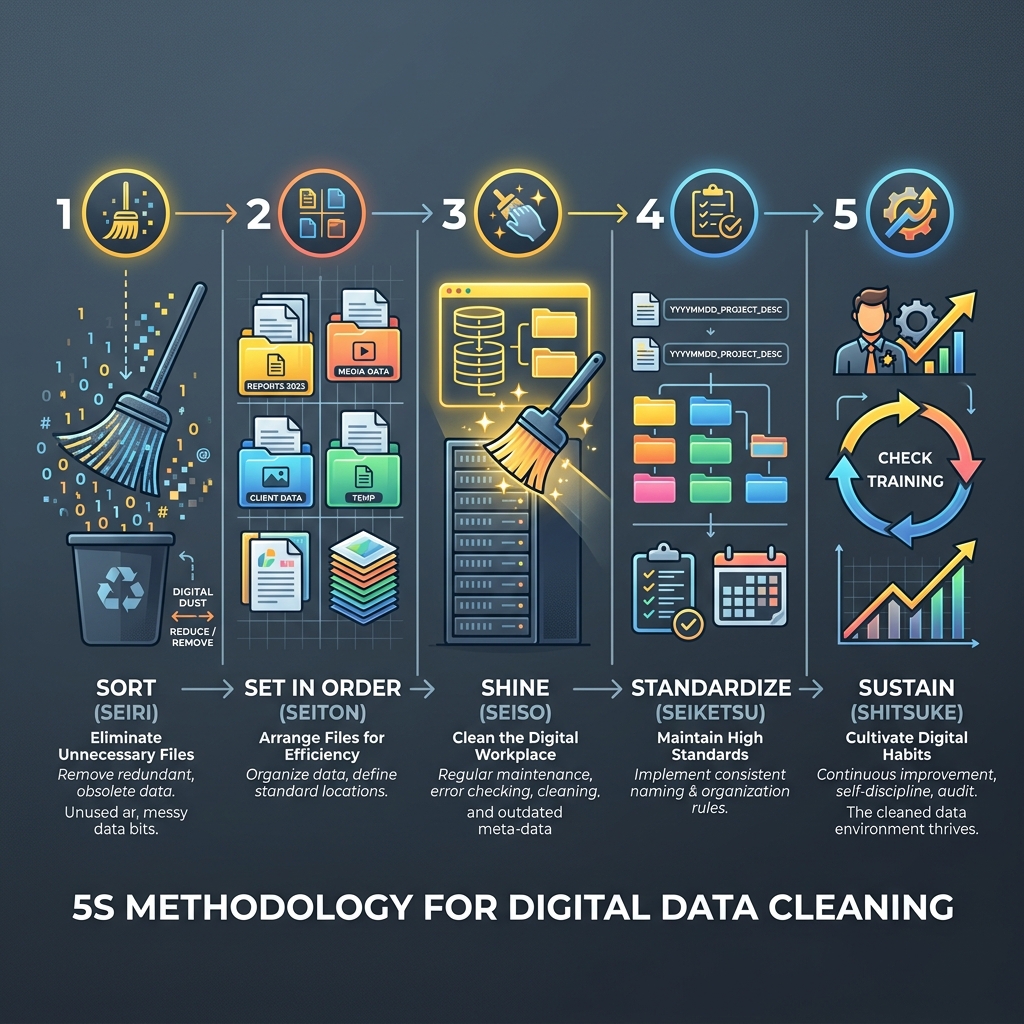
During the digital transformation process in manufacturing, the quality of master data management (Master Data Management, MDM) directly determines the success or failure of MES (Manufacturing Execution System) and ERP systems. Many factories have disorganized bottom-layer databases filled with duplicates, outdated and erroneous data, causing high-level AI analysis and real-time dashboards to become mere empty talk.
This guide applies the long-standing5S (organization, standardization, cleaning, cleansing, cultivation)concept, cross-applied to master data management and optimization. Through structured 5S methodology, establish for organizations a highly available, extremely clean and self-maintaining data management system.
一、 SEIRI (整理) — Identify and Remove Redundant Junk, Keep Only Necessary Critical Data
- Implementation Method (How): Systematically identify and remove any duplicate, outdated or no longer used master data, keeping only core operational essential key items.
- Strategic Value (Why): Clear the «data noise» in databases, can significantly reduce computational interference, make data maintenance and system operation efficiency increase by multiples, help systems achieve extreme slimming.
Execution Steps:
- Conduct comprehensive inventory of existing master data items, including product numbers (Part Numbers), product physical attributes and quality inspection standards.
- Utilize system log analysis (System Log Analysis) to evaluate the actual invocation and usage frequency of these data items over a period of time in the past.
- Redefine and clarify data usage contexts and flow paths.
- Decisively eliminate no longer used redundant junk data, and confirm impacts with key stakeholders (Stakeholders).
二、 SEITON (整顿) — Structured Classification & Positioning, Establish Data's Golden Chain Linkage
1. Establish «Unique Source of Truth»
- Core Definition: In the organization internal, the most reliable, most precise single data source that is publicly recognized and technically architecture locked.
- Value Manifestation (Why): Ensure all organizations, cross-system usage are using the same set of «golden data». Using consistent and high-trustworthiness data can significantly reduce friction in system interconnection, eliminate transmission errors, and ensure high-level business decisions are built on precise error-free intelligence.
- How to Implement (How): Clearly define who is responsible for creating each piece of data, which system it exists in (such as ERP or PLM), how MES reads and updates; establish clear data governance (Data Governance) processes and permission limits.
2. Divide «Product Family»
- Core Definition: Group related products that share the same manufacturing process, original materials, processing equipment, and quality characteristics through logical categorization and packaging.
- Value Demonstration (Why): Through standardized classification of product families, the MES can achieve highly flexible production scheduling and execution. Since material and process logic is highly modularized, it effectively reduces on-site production variability, keeping manufacturing quality fluctuations and potential human errors at a minimum.
- Implementation Method (How): Analyze the manufacturing routing of existing products; evaluate customer requirements and market trends, then group highly similar process products under the same Product Family project to simplify main data file maintenance costs.
3. SEISO (Sealing/Cleaning) — Establish automated validation mechanisms to maintain data's golden quality
- Implementation Method (How): Develop and establish rigorous standard operating procedures for main data creation (Creation) and validation (Validation), ensuring all newly written data is precise and real-time.
- Strategic Value (Why): If '整理' is clearing garbage, then 'sealing/cleaning' ensures new garbage doesn't enter. Through real-time field prevention (Poka-yoke) during data writing and automated format validation, dirty data is eliminated at the source.
4. SEIKETSU (Cleaning) — Standardize data governance processes, locking the orderly state of data
Standardize the implementation results of the aforementioned '整理,整顿,清扫'. Establish enterprise-wide data management regulations, clearly defining 'data administrators (Data Stewards)' and maintenance responsibilities for each department. Through standardized forms and regular main data health checks (Data Health Audit), lock down the clean database state through institutional methods to maintain long-term operational cleanliness.
5. SHITSUKE (Cultivation/Cultivation) — Cultivate the organization's data self-discipline culture, integrating 5S into daily habits
This is the most difficult yet core step of 5S. Through continuous educational training, case sharing, and performance metric management, embed the awareness that 'maintaining data quality is a shared asset protection responsibility' into the daily work habits of every production manager, product controller, and IT engineer. Only by establishing enterprise-wide 'data literacy (Data Literacy)' can the core brain MES of the smart factory always remain in an agile, efficient, and highly resilient peak state.