
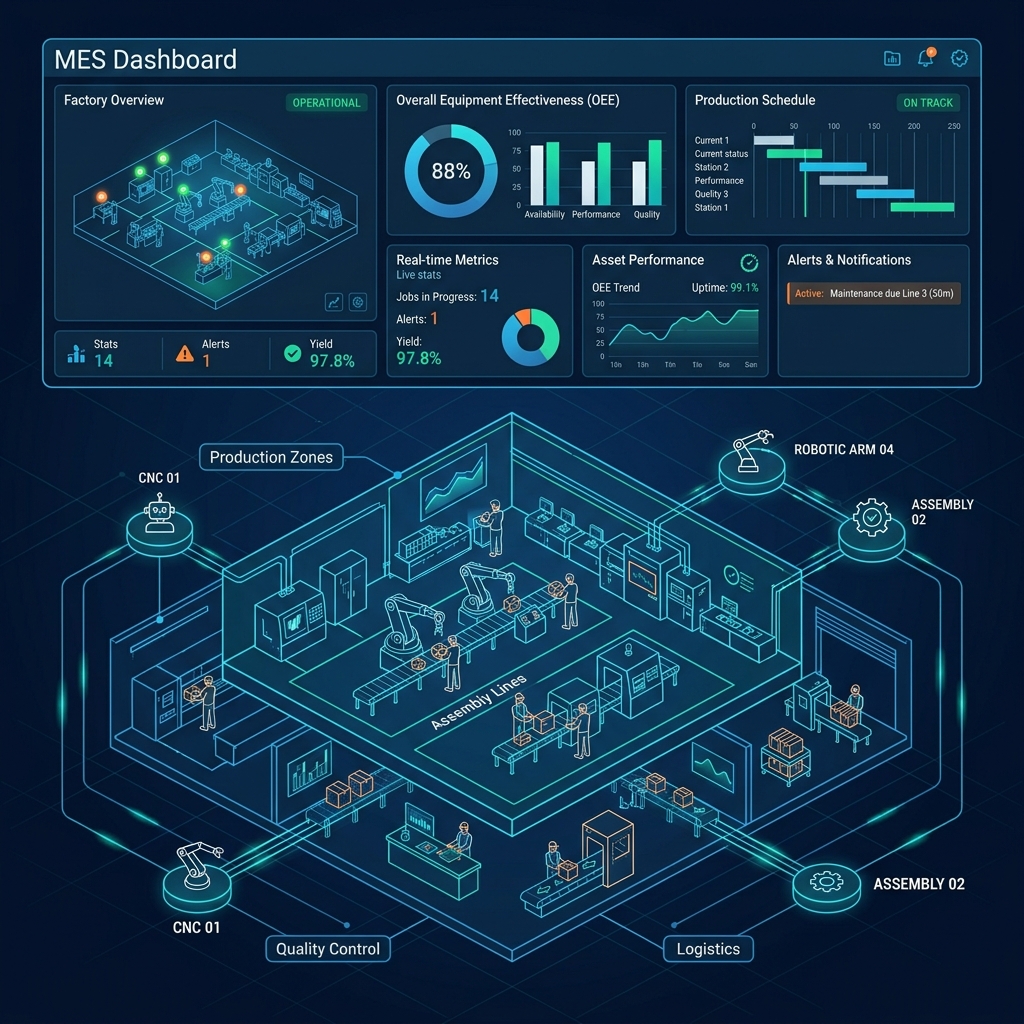
As the artificial intelligence (AI) surge sweeps the global economy, manufacturing enterprises are eager to apply AI to production operations. However, amid intense discussions around "capacity forecasting," "dynamic yield modeling," and "early defect diagnosis," most industry players have forgotten the foundational concept widely discussed a decade ago—"Big Data." Grounded in the physical reality and information architecture of manufacturing, this article demonstrates why, without robust and honest ground-truth MES data, even the most sophisticated AI models remain nothing more than castles in the air.
I. The Real Focus of Factory AI: Executive "Predictive Power"
Across every sector, businesses are exploring how AI can multiply productivity, and manufacturing is no exception.
However, the factory floor is governed by the laws of physics, mechanical machining, and chemical reactions. AI cannot step onto the shop floor to tighten screws, nor can it materialize machine tools out of thin air. In the current spectrum of industrial applications, AI's primary appeal to executive management lies in providing a "transparent, forward-looking operational perspective"—in other words, "Prediction."
Industry expectations for industrial AI center around two core operational scenarios:
- Dynamic Capacity and Yield Forecasting: Accurately predicting daily or weekly output based on real-time dispatching and Work-In-Process (WIP) status; predicting the final pass rate of specific work order batches based on historical process parameters.
- Early Defect Detection and Warning: Identifying subtle sensor drifts or intermediate part anomalies at early production stations, catching deviations before defective units multiply or flow into expensive downstream operations.
Both goals are technically sound and represent the ultimate vision of smart manufacturing. Yet on the path toward this vision, most enterprises overlook a harsh technical reality.
II. The Technical Truth: The Bottleneck is Not Algorithms, But "Forgotten Big Data"
Many manufacturing executives hold the misconception that factories failed to achieve accurate predictions in the past due to a lack of advanced Deep Learning or Large Language Models (LLMs).
In reality, from the perspective of statistics and industrial engineering, the mathematical capabilities required for capacity forecasting and anomaly detection have been mature for decades. Even without any AI algorithms, classical Statistical Process Control (SPC), multivariate regression, time-series analysis (e.g., ARIMA), or decision trees possess the complete mathematical power to achieve these goals.
Why, then, have most factories struggled to predict outcomes effectively over past decades?
The bottleneck has never been algorithm sophistication, but rather the concept celebrated a decade ago and now largely neglected—"Big Data."
An AI model is merely an engine; high-quality big data is the refined fuel that drives it. Without massive, high-frequency, and pristine data inputs, the most complex deep neural network simply idles. Factories demand the predictive dividends of AI while routinely failing to produce the requisite data fuel on their shop floors.
Capacity & Delivery Forecast
Dynamic estimation of daily output and fulfillment
Dynamic Batch Yield Prediction
Estimating final quality via in-process parameters
Early Anomaly Warning
Catching parameter drift early to eliminate scrap
Precise Execution Timestamps
Real-time Track In/Out, eliminating batch scanning
Granular Defect Root Causes
Honest defect coding, eliminating generic "Other"
Governed Master Data
Strict BOM/Routing alignment with closed-loop ECN
Falsified timestamps + generic defect buckets + drifted master data ➔ Severe algorithmic hallucinations and overfitting ➔ Inaccurate predictions causing scheduling chaos.
III. The Three Fatal Data Quality Traps: Why AI Cannot Learn
A rigorous audit of the databases in typical manufacturing plants reveals three pervasive vulnerabilities in the data fed to algorithms:
In many plants, reporting remains trapped in "shift-end bulk scanning" or "paper logging followed by next-day manual data entry." Track In and Track Out timestamps recorded in the system are completely decoupled from actual physical machining cycles. When the time-series timestamps are inherently falsified, any AI capacity forecasting model built on temporal features is mathematically guaranteed to fail.
When non-conformances occur, rushed operators frequently categorize all scrap under a catch-all "Other" code. Alternatively, to evade station yield penalties, teams hold defectives across upstream stations and scrap them en masse at the final inspection gate. This distorted, discontinuous quality trail destroys the causal feature structures required for machine learning.
Unrecorded substitute materials deployed on the floor without ECN logging, combined with informal station-skipping and verbal routing deviations, create severe data drift. When a single part number's physical processing path diverges continuously from its system definition, AI algorithms cannot extract statistically valid patterns.
In computer science, an eternal law holds true: "Garbage In, Garbage Out."
AI is analogous to a multimillion-dollar high-precision machine tool: if the raw material fed into it is contaminated with grit and debris, no matter how fast it runs, it can never produce precision parts. Attempting to build AI predictive models on a foundation of distorted, incomplete data is a futile endeavor.
Initiate Smart Manufacturing AI Assessment
Factories seek AI to achieve scheduling prediction and early defect warning. The critical branching point is shop-floor data integrity.
Trend-Chasing Path (AI Bubble Roadmap)
Deploying AI models without solid MES foundation ➔ Ingesting delayed reporting and coarse defect data ➔ Severe model hallucinations and overfitting ➔ Forecasting failures disrupt dispatching ➔ Project failure.
Grounded Path (MES Data Refinery Roadmap)
Leveraging MES to secure real-time timestamps, granular defect taxonomy, and SSOT master data ➔ Validating causality via classical statistics ➔ Introducing AI for high-dimensional feature modeling ➔ Robust decision loop.
Establish a Trustworthy Smart Decision Closed Loop
When high-purity industrial big data becomes institutionalized, AI can genuinely unlock predictive power and prescriptive guidance, driving continuous evolution.
IV. Strategic Clarity: MES as the Ground-Truth Data Refinery
Faced with the AI wave, manufacturing leaders must establish clear strategic priorities rather than chasing trendy commercial packages.
In modern smart manufacturing architecture, a Manufacturing Execution System (MES) is far from an outdated administrative logger—it is "the sole enterprise pipeline capable of guaranteeing Single Source of Truth (SSOT) integrity and complete operational context."
Before demanding answers from AI, a factory must master three data disciplines through MES:
- Real-time Synchronicity: Accelerate barcode scanning and OT-IT machine connectivity to ensure operation start and end times reflect physical reality.
- Granular Taxonomy: Enforce a disciplined defect coding structure so every quality event maps accurately to machine, tooling, lot, and operator.
- Master Data Consistency: Enforce strict ECN change governance to ensure digital records maintain a strict 1:1 correspondence with the physical line.
V. Conclusion: Understanding Technical Limits to Secure the Next Step
Grasping future technology trends is an essential executive capability. Yet in manufacturing, digital transformation success is determined not by the grandeur of one's vision, but by the willingness to master the foundational engineering groundwork.
Do not build AI skyscrapers on uncompacted mud. Diligently utilize your MES across every work order and station to cleanse, refine, and accumulate high-purity industrial big data.
When factory data possesses truthfulness, completeness, and real-time accuracy, even classical statistical models yield formidable predictive power. And on that day, AI will truly become the wings that propel the factory forward.