
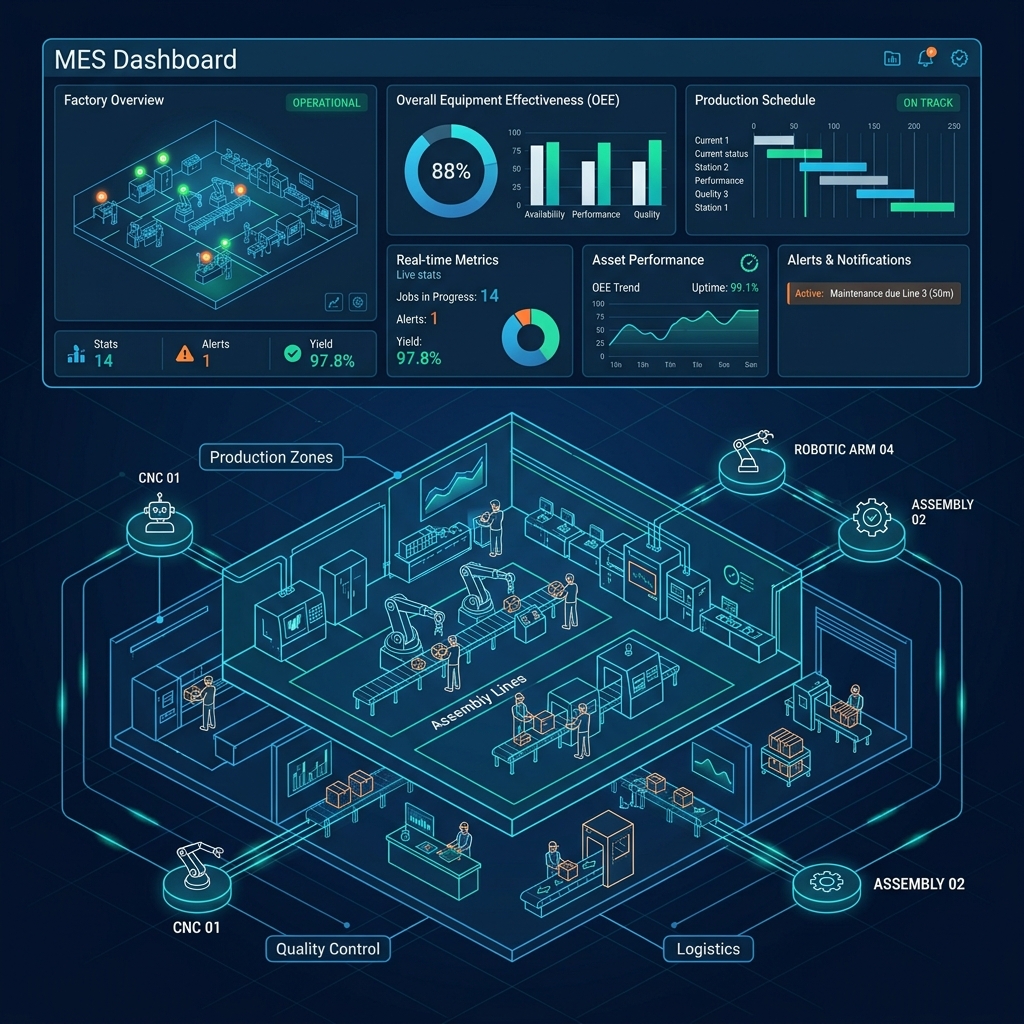
In the wave toward smart manufacturing and digital transformation, the Manufacturing Execution System (MES) is undoubtedly regarded as the factory's core brain. Many enterprises, when selecting an MES system, often fall into the trap of blindly pursuing the notion that "more functions are better." Looking through product catalogs from various software vendors or referring to standards defined by the Manufacturing Enterprise Solutions Association (MESA), MES systems encompass a staggering array of 11 major core functions including resource allocation, detailed scheduling, on-site maintenance, quality management, and more.
However, overgreed often marks the beginning of disaster. Enterprises must recognize a reality:We cannot expect a single MES system to cover every function comprehensively or address all aspects.Attempting to cram all fragmented needs from individual departments into one system will only make it bloated and unmanageable, eventually turning it into expensive bloatware. Rather than pursuing completeness in the function list, enterprises should focus on the robustness of the underlying architecture. As long as the MES possesses three core architectural forces (Features), it can adapt to changing conditions and meet future ten-year scalability requirements.
The MES we want is a stable and usable "platform"
Before delving into these three core Features, we must first clarify a concept: modern enterprises need an MES that should not merely be a rigid "tool," but rather a stable and highly available"Platform (Platform)"。
Traditional MES systems are often custom-developed for specific production lines at particular times. When factory operations run smoothly, it indeed serves its purpose; however, as soon as the market environment changes or processes shift, this tool becomes obsolete, requiring enormous costs to redevelop.
A truly competent MES platform must be like an operating system for a smartphone, possessing extremely high stability and availability. Its underlying core is very solid, not shaken by frequent on-site adjustments; simultaneously, it must provide standardized frameworks and good extension interfaces, allowing enterprises to easily add and correct different business logics without compromising core stability, much like installing Apps. Only when positioned as a "platform" can the MES truly become the foundation for stable factory operations in the digital transformation wave.
To build such a high-resilience platform, the following three underlying Features are absolutely non-negotiable core elements:
Core Feature One: Integration at the Database Layer (Database Layer Integration)
Firstly, the primary condition of a quality MES platform is to possess an extremely structured data model.
Many traditional MES systems adopt a "patchy" approach in database design during factory expansion or function addition. Today, production management adds a field arbitrarily; tomorrow, product assurance opens another table for an inspection item, resulting in a chaotic and unorganized underlying database. When enterprises later wish to perform big data analysis, production dashboard planning, or even high-level AI predictive maintenance, IT personnel must write incredibly complex and inefficient SQL syntax just to create cross-database queries (Joins), severely degrading system performance.
An MES with "Database Layer Integration" considers future expansion and correlation in its underlying data model design. It follows international standards (such as the ISA-95 standard) to plan a complete production topology structure, ensuring all data has structured attribution from inception.
Such design brings enterprises unparalleledEnd-to-End Traceability, for example:
- Reverse Tracing: When customers on the market side react to product defects, quality assurance personnel can simply scan the "Shipping Label" on the product.
- Structured Linkage: The system can easily trace upwards in reverse within seconds by following highly structured database correlation paths.
- Precise Anchoring: From the shipping label, it precisely corresponds to the original "Production Work Order," then checks the specific "Work Order Material Injection Time Point," and even identifies the "Original Material Batch (Material Batch)" used for that batch of products and upstream suppliers.
This high-structured database integration allows enterprises to isolate risks at the fastest pace when facing quality crises, which is also an indispensable data foundation for smart factories.
Core Feature 2. Business Logic Layer Flexibility
Secondly, the MES platform must be extremely adaptable at the business logic layer, which needs to be achieved through the concept of Design Patterns and the characteristics of Object-Oriented Programming (OOP).
The only variable at the manufacturing site is "change". In the past, the factory's production line molds may have been simply designed with "one mold, one cavity", and the internal program code of the MES was written as a matter of course: one production action equals one output finished product. However, when market competition intensified, in order to increase production capacity, the factory introduced advanced molds with "one mold with two cavities (or even one mold with multiple cavities)". At this time, if the logic layer of the MES lacks flexibility and the program code is filled with a large amount of hard-coded linear logic, the IT team will have to open thousands of lines of source code and make drastic modifications. This is not only time-consuming and labor-intensive, but can also easily lead to unexpected errors that cause the system to crash.
If MES implements object-oriented and design patterns (such as Strategy Pattern or Factory Pattern) in the design of the logic layer, the situation will be completely different:
- Object encapsulation: The system will package entities such as "mold", "equipment" and "output" into independent objects.
- logical abstraction: The behavior of production is abstracted into a standard interface, and "one hole" or "two holes" are just specific execution strategies.
- Minimize changes: Faced with the new demand of "one mold, two cavities", IT engineers no longer need to change the core architecture. They only need to "inherit" the objects of the original mold and exchange or superimpose the output calculation strategy.
Through this highly flexible software engineering design, the system can respond to completely different business needs with the least amount of changes, the shortest time, and the lowest risk, significantly reducing the total cost of IT system maintenance (TCO) of the factory in the future.
Core Feature 3. An ecosystem that can flexibly connect to the outside world (Out-of-the-Box Connectivity)
The third key feature is that the MES system must be ready with an out-of-the-box (OOTB) interface and have strong external connection capabilities.
Modern smart factories cannot operate on a single system, and MES must not become an information island. Upward, it needs to synchronize work orders and materials with the ERP (Enterprise Resource Planning) of the enterprise operation layer; downwardly, it needs to connect with the automation equipment, PLC, OPC server, or SCADA/Historian (historical database) at the production site for real-time process parameters.
Traditional MES often requires costly and lengthy system integration (SI) customization development when integrating these systems. Once the device changes the communication protocol, or the ERP fields are slightly adjusted, the entire communication link may be broken.
A MES with a modern architecture should provide a "Low-code/No-code" configuration experience:
- Pre-built mainstream interfaces: When the system leaves the factory, it has built-in standard RESTful APIs for connecting to mainstream ERP (such as SAP, Oracle), and standard drivers for connecting to the Industrial Internet of Things (IIoT) such as OPC UA, MQTT, and Historian.
- Just set the master file and you’re done.: When new equipment is introduced on site or docking fields need to be adjusted, engineers do not need to rewrite the communication program. They only need to log in to the MES management background and perform visual field mapping and checking through "Master Data" to complete the interface configuration in a few minutes.
This flexible external connection capability allows MES to be like a developed neural network, perfectly connecting the upper and lower levels of information in the factory, and truly realizing digital lean production.
Conclusion: Respond agilely to changing business environments with a flexible platform
There are specializations in the technical industry. In the digital blueprint of the enterprise, each set of software has its own exclusive professional capabilities and strengths. ERP is good at financial and resource planning, WMS specializes in warehousing and logistics, and PLM focuses on product research and development and process design. We must understand that no set of MES can perfectly possess the capabilities of software in other fields at the same time, and any idea of trying to make MES play a universal role is unrealistic.
Faced with today's rapidly changing business environment, geopolitics and supply chain fluctuations, what manufacturing companies need most is not a giant software that claims to be omnipotent but too big to lose, but a software that integrates the underlying data structure, has object flexibility in the logic layer, and can be used for flexible external connections out of the box."Stable platform"。
With such a highly resilient underlying platform architecture, no matter how the future process is renovated, how the business model changes, or how advanced AI applications need to be connected, enterprises can easily respond with the most agility and always stay ahead on the future smart manufacturing track.