
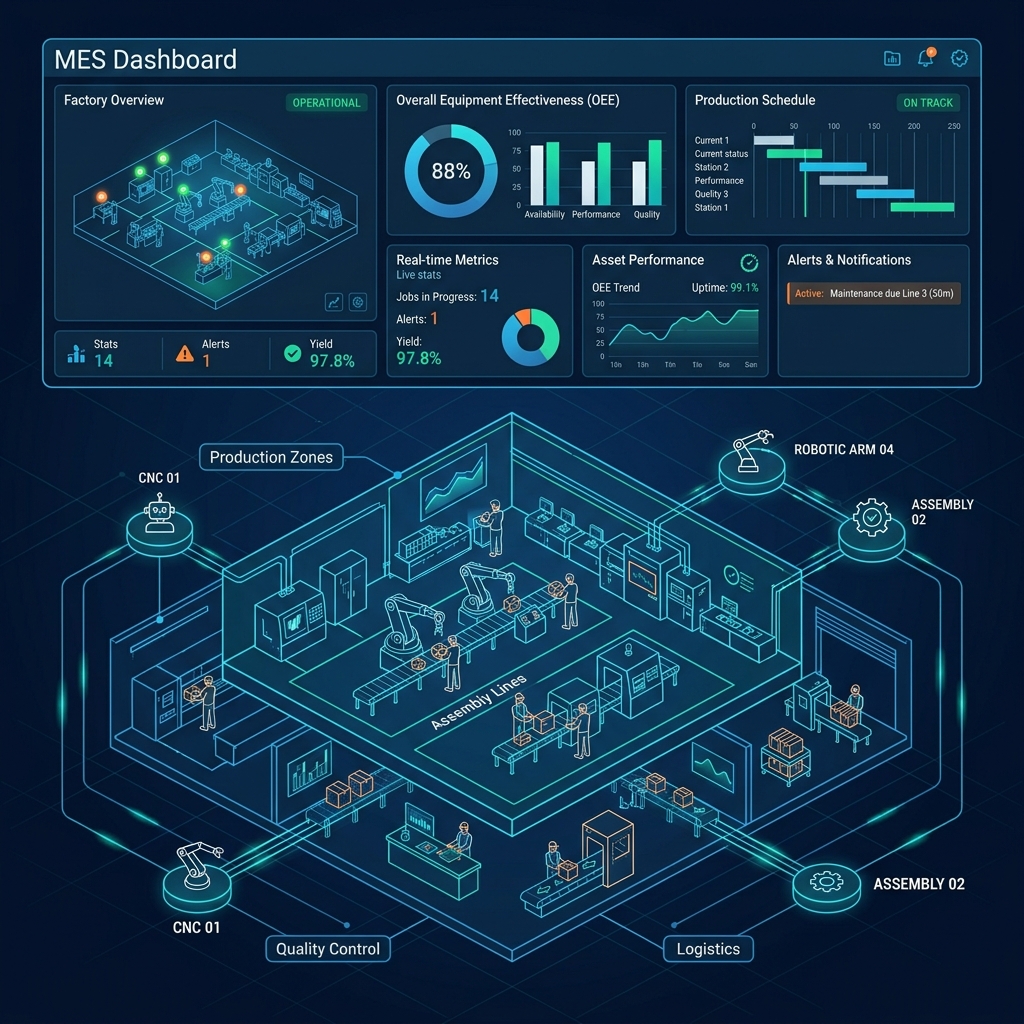
In the global wave of digital transformation and smart manufacturing, many enterprises fall into the misconception that "purchasing top-tier, world-renowned software will solve all operational bottlenecks." Starting from the architectural essence of Manufacturing Execution Systems (MES), this article deconstructs the mechanics of modern Configuration-Driven (Config-Driven) platforms. Through three real-world cases, we reveal how the rigid logic of advanced systems can backfire disastrously when introduced into an organization with insufficient management discipline.
I. Dispelling the Brand Myth: Tool Value Depends on Organizational Bearing Capacity
In enterprise IT and smart manufacturing consulting, a classic phenomenon frequently recurs: senior management invests tens of millions to introduce premier Western MES platforms, expecting to achieve Industry 4.0 standards overnight. Yet after go-live, what follows is not a leap in operational efficiency, but production standstills, fierce operator resistance, and endless system backdoors—eventually degrading a multi-million-dollar platform into nothing more than an "expensive electronic ledger."
This reflects a fundamental blind spot: the value of software is never defined by its procurement price or functional complexity, but by its degree of fit with the enterprise's operational maturity.
Commercial MES architectures vary widely, ranging from highly customized project-based systems to strictly standardized, configuration-driven platforms. Top-tier systems are expensive because they encapsulate the operational standards of highly mature manufacturing paradigms. However, if a factory's underlying production management lacks equivalent discipline, imposing such a system will inevitably trigger severe organizational rejection.
II. The Architectural Essence of Advanced MES: Zero Shop-Floor Overhead via Extreme Standardization
Modern advanced MES platforms (such as Low-Code / No-Code configuration engines) are considered industry benchmarks because their core design philosophy is: "Decouple complex business rules from shop-floor manual operations, encapsulating them entirely within backend configuration (Config-Driven) and object models to minimize operator burden and human error."
In traditional or low-tier systems, the software acts as a passive recording tool. Operators must manually select operations, enter work orders, and key in inspection parameters. While such systems offer high fault tolerance for chaotic processes, they are plagued by human arbitrariness.
In contrast, modern object-oriented MES enables an operator to simply scan a barcode (Track In). The system automatically inherits the product's Base Routing, Bill of Materials (BOM), equipment Recipe, and Quality Control Limits (QC Limit). Ideally, upon Track Out, material backflushing and genealogy tracking execute automatically with zero manual friction.
However, the leverage of automation is strictly governed by the purity of input data and the discipline of underlying rules. When decision authority is completely consolidated into backend logic, any flaw in ground-level management will be amplified exponentially.
Product Family
Unified family definition, deriving hundreds of part numbers
Inherit Base Route
Automated binding to Standard Operation Codes (OpCodes)
Inherit QC Limit
Automated upper/lower limits & poka-yoke interlocking
Master Data SSOT
Strict ECN governance and impact audit reviews
Exception Governance
Standardized customer-specific specs, no verbal bypasses
Ground-Truth Integrity
Real-time honest reporting, eliminating shortcuts
Without robust ground management, automated configuration inheritance rapidly spreads erroneous parameters. Algorithmic misjudgments freeze production lines, forcing factories to open administrative backdoors that render the multimillion-dollar system obsolete.
III. Advanced Weapons Encountering Organizational Disorder: Three Real-World Cases
In object-oriented system architecture, "Product Family" inheritance is an elegant mechanism to slash maintenance overhead. Products sharing similar routing and quality parameters inherit from a parent family, allowing engineers to maintain rules at the family level across hundreds of part numbers.
However, this mechanism fundamentally presumes strict Master Data Governance and Engineering Change Notice (ECN) discipline.
In loosely managed plants, R&D and production planning frequently force products with subtle process variances into a single family to meet tight deadlines, or modify family parameters without impact analyses. Consequently, dozens of downstream products inherit erroneous oven baking times or inspection tolerances, causing massive scrap. To patch the damage, engineers create endless part-level overrides, transforming an elegant inheritance model into a bloated, untouchable legacy liability.
Advanced MES features powerful real-time quality poka-yoke: whenever an in-line measurement violates statistical control limits (Out of Control), the system immediately places the lot on Hold and logs an electronic Audit Trail.
In standardized environments, this guarantees quality. But when deployed in a plant dominated by an "exception culture," it creates deadlock. Examples include unrecorded customer-specific tolerances, pilot lots requiring temporary parameter relaxation, or supervisors granting verbal release under delivery pressure.
Because these non-standard operations cannot be recognized by predefined rules, the rigid MES relentlessly halts production across work centers. Faced with production paralysis, the organization's final game-theoretic response is not to mend management discipline, but to force engineers to widen control limits to infinity or share master override accounts. The rigid quality module becomes a dead letter.
High-tier MES intelligence relies on real-time shop-floor feedback—actual output, yields, and granular defect codes—to execute dynamic line balancing, automated dispatching, and replenishments.
Under traditional operations, experienced supervisors and operators possess strong "empirical compensation and fault-tolerance capacity." They understand specific machine eccentricities, recognize minor defects that can be reworked downstream, and maintain throughput under non-standard conditions.
However, when a purely algorithmic MES is introduced without rigorous reporting discipline (e.g., operators understating defect counts to meet KPIs or batching multi-station scrap into the final station), distorted data causes scheduling and replenishment algorithms to fail completely. Worse, the rigid software severs the buffer zone of human empirical judgment. The factory can neither provide precise data nor leverage traditional flexibility, resulting in severe material misallocation and shop-floor gridlock.
IV. Deep Logical Deconstruction: Software is an "Amplifier," Not a "Remedy"
Many corporate executives harbor a perilous assumption: "Precisely because our factory management is chaotic, we must introduce the most stringent MES to force the team into discipline."
In system dynamics and project management, this is a fatal inversion of causality.
Software is inherently an "amplifier"—it amplifies the efficiency of standardized workflows, but equally amplifies the destruction of chaotic ones. Digitizing an unstandardized business process full of verbal agreements and informal compromises does not yield smart manufacturing; it produces "Digitalized Chaos."
Poka-yoke error-proofing requires that operational boundaries and standards have achieved full organizational consensus. If the rules fluctuate daily through arbitrary exceptions, systemic rigidity will only drive the shop floor toward institutionalized falsification and workarounds.
Initiate Digital Transformation & MES Selection Assessment
Avoid brand fetishism and feature obsession; begin by rigorously diagnosing the plant's actual production management maturity.
Premature Leap Path (Strong Medicine on Weak Body)
Imposing advanced Config-Driven MES on chaotic management ➔ Proliferating exceptions and unmanaged master data ➔ Rigid interlocks freeze lines ➔ Forced administrative backdoors ➔ System degrades into an expensive ledger.
Offline Validation Path (Recommended)
Execute "Offline Process Discipline Validation (No-System Test)" ➔ Verify 100% adherence under Excel/paper ➔ Solidify SSOT and ECN mechanisms ➔ Select an MES matching current maturity.
Staged Evolution: Co-growth of Factory and System
Deploy a platform balancing standard rules with extensible flexibility. As master data and shop-floor discipline mature, progressively unlock advanced automated configurations to achieve a sustainable virtuous cycle.
V. Conclusion: Recognizing Limits and Returning to the Essence of Management
The traditional medical principle that "a weak body cannot bear strong medicine" captures a profound truth of balance between input intensity and structural bearing capacity: administering potent tonics to a frail constitution does not nourish, but overwhelms internal systems.
When evaluating modern MES, the most critical executive virtue is not the size of the IT budget, but "the sober honesty to understand one's operational boundaries."
Before procuring an MES, enterprises must examine three core benchmarks:
- Is Master Data Single Source of Truth (SSOT) established with clear ownership?
- Are exceptions and engineering changes handled via institutionalized workflows rather than informal bypasses?
- Is shop-floor reporting timely, truthful, and traceable?
If these foundations remain fragile, the organization's priority must be offline workflow convergence and discipline cultivation. Choose a system with clear architecture and reasonable fault-tolerance, progressively unlocking higher automation as maturity deepens.
Let the system evolve in tandem with the factory, rather than letting an advanced tool fall victim to organizational disorder. Only by securing the operational foundation can digital transformation proceed on solid ground.