
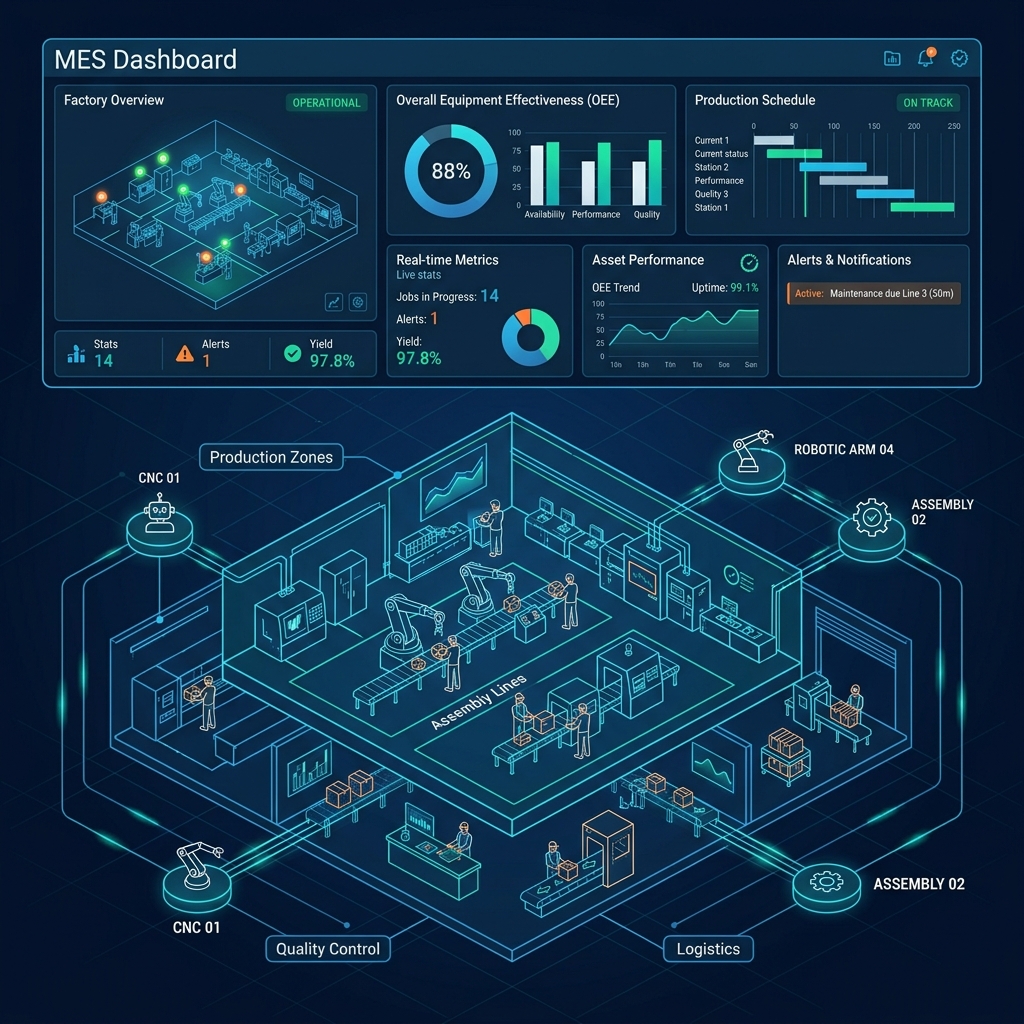
In shop-floor digital transformation meetings, one frequently encounters a dangerous argument: "As long as the software vendor provides the source code, we can modify it freely to cater to whatever operational habits the shop floor demands." This myth of "source code freedom" is all too often the starting point of organizational chaos and system abandonment. Behind software lies production process discipline and data governance; possessing source code is a technical asset, but it is never the decisive silver bullet for factory cost and efficiency. Modifying code without rigorous process review only invites self-inflicted disaster.
1. The Illusion of Code Omnipotence: Software Is Not Malleable Clay
The most common blind spot among enterprise managers is confusing "having the technical ability to modify code" with "having the justification to alter business rules." On the shop floor, people instinctively view "software systems" through the same lens as "physical machines." Yet architecturally, the two are fundamentally distinct:
Physical Machines & Tooling (Physically Isolated)
Adjusting a pneumatic cylinder stroke or swapping fixtures affects only a single workstation. If an adjustment fails, loosening screws restores the original state, offering physical reversibility.
Manufacturing Execution Systems (Mesh Coupled)
Data flows across work orders, inventory backflushing, inspection, and product costing. Altering station logic triggers cascading ripple effects plant-wide; once historical data is tainted, the damage is irreversible.
When operators complain that scanning barcodes during material changeovers takes too much time, IT might casually comment out the validation logic. The consequence? Unchecked wrong parts, line-side inventory drift, month-end financial variances, and ultimately, an irreparably severed Genealogy traceability chain when customer defects arise. In a mesh-coupled system, modifying logic at will is equivalent to creating arbitrary short circuits across an electrical power grid.
2. Inviolable World Standards: The Industrial Engineering Axioms Behind the Code
MES core logic is not arbitrary code conceived by programmers; it is the concrete realization of a century of Industrial Engineering (IE) science. Whether an enterprise owns the source code or not, these world standards function as an unyielding factory constitution:
- Standard Work Hours & Line Balancing: The scientific bedrock for capacity planning and cost accounting; closing work orders with zero recorded time must never be tolerated.
- BOM Verification & Poka-Yoke: Validating materials against product recipes is the non-negotiable safeguard against mix-ups.
- Statistical Sampling Rules (AQL / C=0): Quality defenses grounded in probability theory that must never be bypassed to expedite shipments.
- Genealogy Traceability Topology: Mathematical lot splitting and merging structures that guarantee rapid containment during recall audits.
These axioms exist precisely to restrain human inertia and sloppy habits; using source code to cater to backward practices is merely using technology to mask managerial capitulation.
Scope & Media
Web frontend screens, button layouts, automated barcode scanning prompts, BI war rooms, and yield Dashboards.
Governance Principle
Modern architectures fully decouple UI from the database; frontend enhancements require no source code modifications, maximizing shop-floor ergonomics.
Scope & Media
Routing templates, inspection sampling plans, machine recipes, branching conditions, and control limits.
Governance Principle
Configured via system parameter files, not hardcoded edits. Any change demands rigorous process rationality review to evaluate quality and throughput impacts.
Scope & Media
Bi-directional genealogy algorithms, state machines, BOM backflush atomicity, blocking logic, and audit trails.
Governance Principle
Represents manufacturing axioms and regulatory baselines; strictly protected from code modification regardless of source code ownership.
3. The 3-Tier Boundary: What to Change, and Where?
Recognizing this essence establishes three unambiguous operational boundaries:
1. Frontend ergonomics require zero source code: Modern mature MES solutions adopt Web standards (HTML5/JavaScript). Enlariging buttons, enabling automated sensor inputs, or building PowerBI dashboards are open peripheral capabilities that in-house IT can freely maintain without ever touching backend source code.
2. Industry manufacturing logic belongs in "Configuration": Different sectors exhibit distinct process sequences and testing criteria. Mature systems accommodate these via configuration files and master data parameters. When shop floors request logical changes, management must ask "Is the current process rational?" rather than "Can we patch the code?" If the request merely conceals disorderly scheduling, Management of Change (MOC) should veto it.
3. Underlying industrial axioms must remain untouchable: The core engine encapsulates non-negotiable traceability algorithms and transaction atomicity. These world axioms demand rigid architectural protection.
4. The Century Counterproof of SAP: Why Does Nobody Touch the Core?
If "owning source code enables arbitrary modifications" were valid, global ERP benchmark SAP would serve as the ultimate counterproof.
SAP's underlying ABAP code is almost completely transparent to customers; technically, any authorized developer can set breakpoints and modify core routines. Yet across Fortune 500 enterprises, no competent architect or CFO ever authorizes core modifications. They understand that those millions of lines of code embody a half-century of accounting philosophy: "Every debit must have a credit, and debits must equal credits" alongside strict "3-Way Matching." If an accountant finds expense reporting tedious and IT comments out verification checks, corporate financial integrity collapses overnight.
On the shop floor, MES represents the accounting philosophy of manufacturing science. Real-time consumption, BOM verification, and traceability chains are the factory's double-entry bookkeeping. Tampering with code to remove error-proofing is just as absurd as abolishing debit-credit balance to simplify bookkeeping.
5. Conclusion: Stop Masking Process Sloth with Code Modifications
Possessing source code safeguards digital asset sovereignty, but it is never the deciding factor for manufacturing competitiveness or operational speed.
The genuine value of an MES is acting like a railway track, compelling production along compliant, standardized paths. Whenever the shop floor seeks shortcuts and IT alters code to "dismantle the tracks," an expensive multi-million-dollar system devolves into an overpriced barcode printer.
Returning to process governance, evaluating engineering rationality, adjusting parameters within standard configurations, and safeguarding world standards through architectural discipline—this is the true foundation upon which manufacturing execution systems endure.