A Few Reflections on Swimming
I love swimming. Its particular grace lies not in the water, but in the air we so often overlook. In this demanding sport, oxygen feels scarce; only by settling all attention wholly upon each breath, precisely governing its rhythm, can resistance be transformed into the utmost speed of forward motion. The water gently cradles the body, dissolving the heavy gravity of land, and every stroke and drive becomes the deepest, most elegant, unspoken dance between human and water.
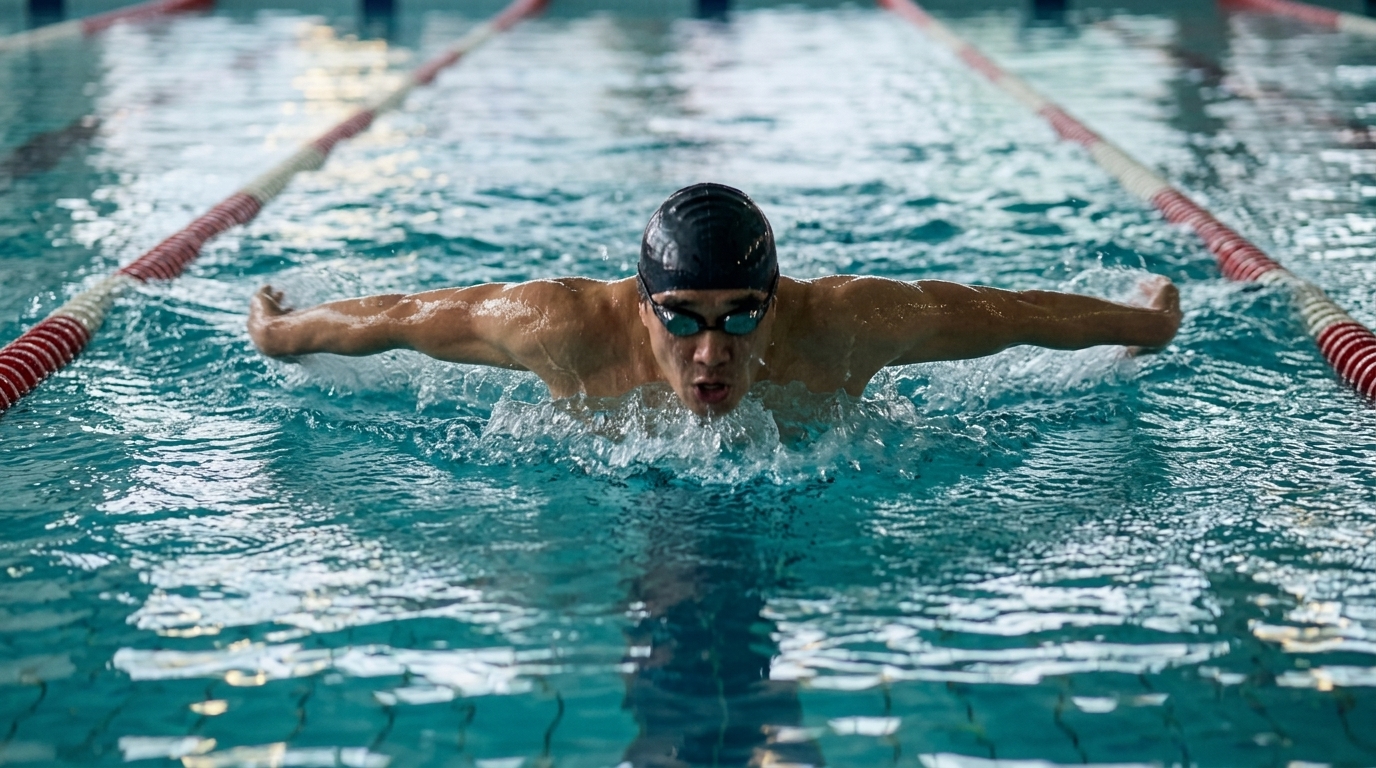
The Four Strokes & Body-Mind Modulation
Beyond stroke biomechanics, breath regulation and energy management represent the true art of swimming. Discovering your inner cadence in the water elevates sport into life philosophy.
Freestyle (Front Crawl)
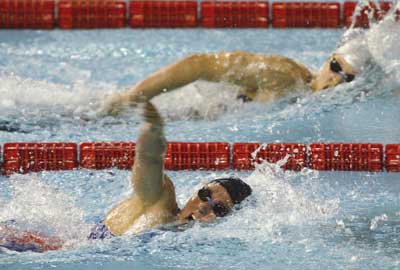
The Speed Realm of Heavyweight KingsFreestyle is the fastest, most biomechanically efficient stroke. Whether in an all-out sprint or long-distance cruise, it synchronizes muscle chains across the entire body. If swimming had weight classes like boxing, the freestyle champion would undeniably be the undisputed heavyweight king.
Butterfly Stroke
Explosive Wings Breaking the WaterButterfly is visually spectacular and physically commanding. Demanding immense core and lumbar engagement, it rapidly elevates metabolic and cardiovascular output. It represents the pinnacle of strength, flexibility, and wave-like cadence.
Backstroke
Serene Cruising Facing the Open SkyBackstroke deeply opens the thoracic cage and stretches posterior muscle chains. With the face continuously above water, breathing remains unconstrained. In quiet distance sets, backstroke offers contemplative serenity suspended between sky and water.
Breaststroke
The Enduring Art of Steady GlideUniversally accessible yet technically subtle, breaststroke builds robust lower-body power. Its distinct rhythm of propulsion and glide conserves vital energy, making it the classic choice for enduring cruises and open-water navigation.
Beyond Athletics: Physical Therapy & Physiological Healing
There is hardly any need to belabor swimming's virtues—it differs fundamentally from any land-bound discipline. It is, in the truest sense, a complete full-body endeavor.
Zero-Gravity Joint Protection
Buoyancy neutralizes terrestrial impact, shielding knees, ankles, and spinal vertebrae while facilitating comprehensive resistance training in the safest imaginable medium.
Aquatic Rehabilitation for Sports Injuries
Physicians frequently prescribe swimming for sports injury rehabilitation. Gentle hydrostatic pressure, soothing water temperature, and mild resistance enhance blood flow, ease muscle tension, and restore functional mobility.
Mindful Breath Modulation
Swimming transforms automatic respiration into conscious cadence control. Each inhalation represents intentional thoracic expansion, guiding the swimmer into a tranquil, meditative state of total focus.
My Swimming Journey & Race Records
From first stepping into the pool as a six-year-old to competing for National Central University at the National University Games. Every flip turn and wall push carved youth's indelible marks into the water.
First Strokes and Aquatic Awakening
First learned to swim in cool pool waters, discovering the joy of effortless buoyancy and gliding—initiating a lifelong bond with the water.
Selected for School Team: 4th Place in Mayor's Cup 100M Backstroke
Joined the school swim team for systematic training; represented the school in the Keelung Mayor's Cup, placing 4th in the 100-meter backstroke.
Earned National Lifeguard Certification
Passed rigorous water endurance and emergency rescue evaluations, attaining official certification with both competitive speed and lifesaving capabilities.
Instructor at Japan's Itoman Swimming School
Served as a coach at the renowned Itoman Swimming School (イトマン水泳学校), mentoring students in precise stroke biomechanics and water confidence.
Selected for National Central University Varsity Swim Team
Joined the NCU varsity squad, undergoing daily foundational conditioning of 400M kick sets and 400M pull sets.
Represented NCU at National University Athletic Games
Stepped onto the national stage for the first time, testing hard-earned training against collegiate elite athletes nationwide.
4th Place Nationwide in University Games 200M Freestyle!
Clocked 2:37.85 in the Men's Division B 200M Freestyle Final at the 1996 National University Games, clinching 4th place nationwide.
Personal Best Records (PB)
Personal Best Swimming Records| Event | Time |
|---|---|
| 50M Freestyle | 29''79 |
| 100M Freestyle | 1'13''03 |
| 200M Freestyle | 2'37''85 |
| 200M Individual Medley | 3'22''67 |
1996 National University Games Swimming Finals — Men's Division B 200M Freestyle
Official Record Bulletin (1996 May 13 4:48:25 PM) · hilosi Kuo Representing NCU Placed 4th Nationally
| Rank | Bib # | Swimmer | Affiliation | Final Time | Note |
|---|---|---|---|---|---|
| 1st Place | 4501 | Huang Yanwen | Fu Jen Catholic University | 2:18.09 | ★ |
| 2nd Place | 4423 | Huang Zhongwei | National Taiwan University | 2:22.56 | ★ |
| 3rd Place | 4560 | Lin Zijing | Feng Chia University | 2:23.91 | ★ |
| 4th Place | 4417 | hilosi Kuo (Kuo Haoyang) | National Central University | 2:37.85 | ★ Site Author |
| 5th Place | 4606 | Chen Xiaowu | Naval Academy | 2:38.14 | |
| 6th Place | 4536 | Liu Jingming | Chung Yuan Christian University | 2:38.22 | |
| 7th Place | 4732 | Wu Xiangxian | Ming Chuan College | 2:38.85 | |
| 8th Place | 4410 | Chang Chunghao | National Central University | 2:41.05 |
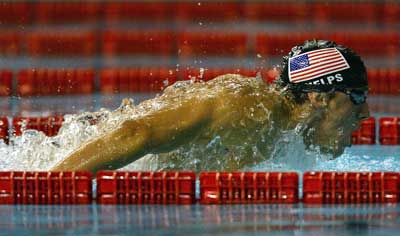
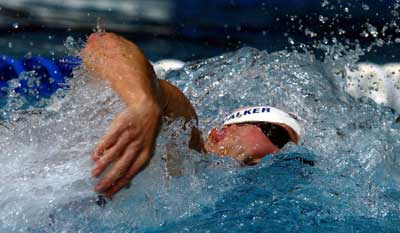
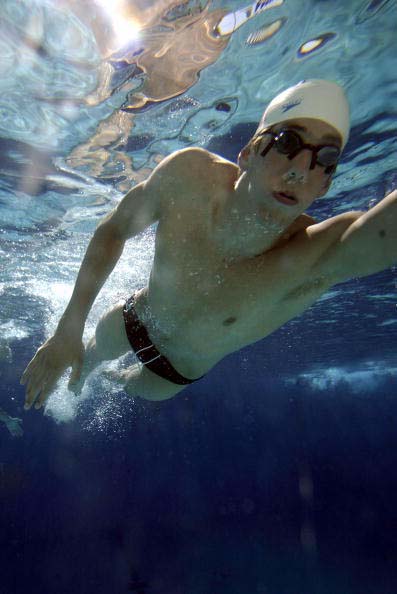
Precious Swimming Memoirs & Imagery
Click any photograph to view in high resolution


NCU Varsity Swim Team Competitive Secrets
"These were originally the hard-won secrets that propelled the National Central University swim team to top-three finishes for multiple generations. Shared here as a tribute to the collective wisdom of our predecessors."
Turning Weapon: Flip Turn Timing & Dolphin Kicks
Turning: Flip Turn & Dolphin KickIn freestyle races, victories are rarely sealed during mid-pool cruising; they are forged at the turns. A clean flip turn is one to two seconds faster than a traditional touch-and-turn. The deciding subtleties include:
Momentum Preservation: Because swimmers exhale during the tumble, instincts tempt them to surface immediately for a massive breath—an urge that instantly destroys the explosive thrust off the wall! The winning approach: pin yourself streamlined against the water, holding your breath to ride that peak exit velocity.
Underwater Dolphin Kicks: Freestyle permits any propulsion underwater, and the undulating dolphin kick offers the lowest drag and fastest underwater velocity of all. Driving forward with dolphin kicks saves crucial arm strength while converting wall momentum into clean forward surge.
Cleaving the Water: Bow Wave Trough & Bilateral Rhythm
Breathing: Bow Wave Trough & Bilateral RhythmMany assume breathing requires little refinement once a basic stroke is acquired. In reality, respiration is the single largest source of hydrodynamic drag. At high velocity, the skull displaces water forward, creating a depression—a "bow wave trough"—along the side of the cheek.
Bilateral 3-Beat Breathing (Inhale every 3 strokes): Beginners are often instructed to breathe only to their dominant side. However, in racing, breathing every two strokes is too frequent and disrupts balance; breathing every four strokes leaves most swimmers oxygen-deprived. Three-beat breathing is the racer's golden mean—supplying balanced oxygen while maintaining stroke symmetry to prevent veering off course.
Pacing Mastery: Energy Allocation in Long-Course Races
Pacing Strategy: Energy DistributionLike all premier endurance sports, pacing is decisive on the racecourse. Adrenaline surges at the gun; anxious competitors frequently sprint the opening 50 meters too hard, paying dearly in the back half with debilitating lactic acid accumulation.
Back to Essence: Kick, Pull & Equipment Conditioning
Fundamentals: Kick, Pull & Hand PaddlesTechnique embellishes, but stamina, flexibility, and muscular endurance form the immovable bedrock. In our varsity squad, entering the pool always began with a non-negotiable ritual: 400 meters kick, 400 meters pull.
Solitary Component Isolation
The body learns through isolation better than conscious cerebration. Dedicating sets exclusively to the kickboard and pull buoy channels focus to specific kinetic links, ingraining flawless motor reflex arcs.
The True Secret of Hand Paddles
Novices assume swimming with paddles is merely for speed or show. In truth, coaches prescribe paddles because water pressure feedback forces swimmers to fine-tune hand and forearm entry angles instantly, building an intuitive, highly efficient "feel for the water" (catch).