
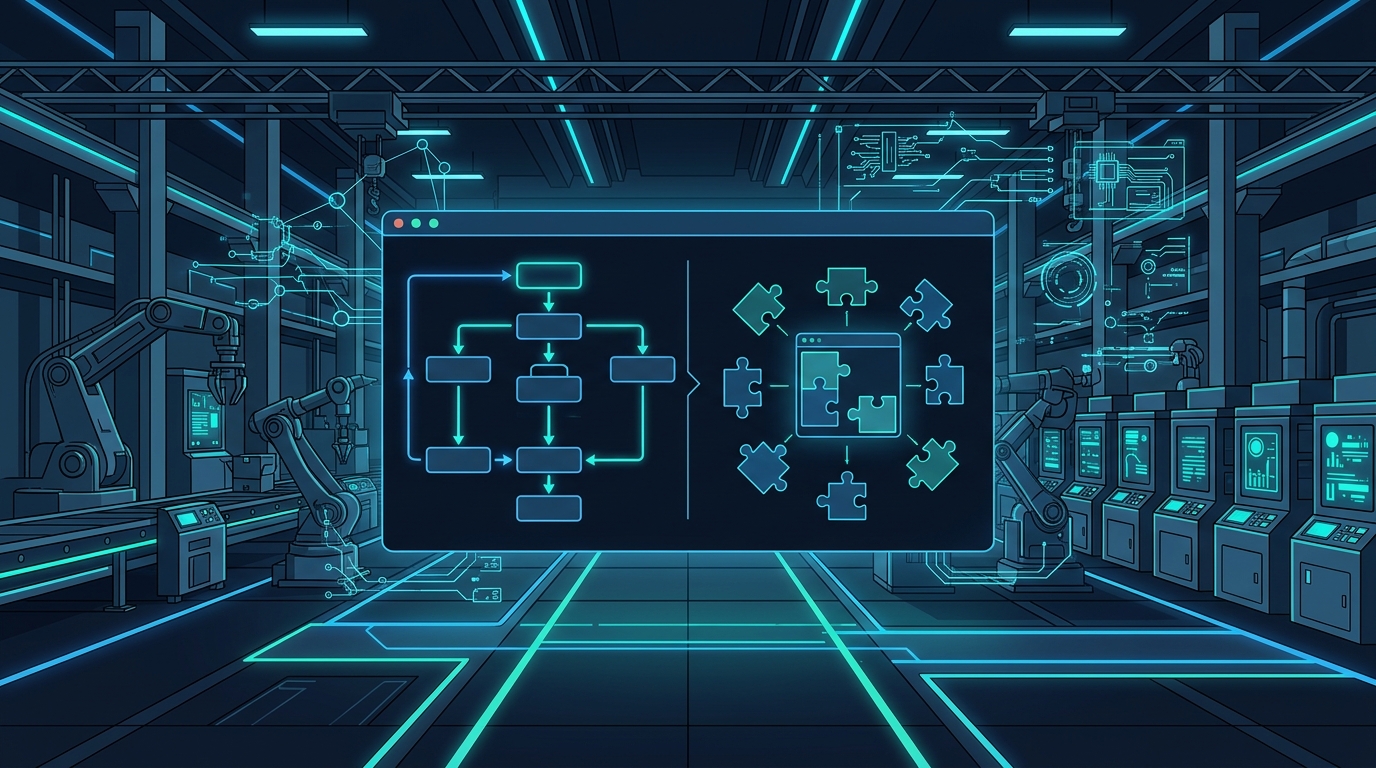
After visiting two factories in Guangdong, China, I observed the Chinese factories' habit and pride of "doing everything ourselves." While I admired this, it also reminded me of the long-standing corporate motto of Western factories: "Commit to our area of expertise." This made me think: should we really try to do everything ourselves? For instance, when implementing an MES system, should we develop it in-house?
When planning a Manufacturing Execution System (MES), enterprises often face a choice: buy a mature package MES or develop a proprietary system from scratch? Many believe that building their own system guarantees a perfect fit for the company's unique needs. However, from the perspective of economic return, organizational management, and long-term maintenance, implementing a mature package MES is a much more robust choice for most enterprises.
I. Purchasing Decades of Accumulated Industry Best Practices
First, when an enterprise purchases a package MES, it is not just buying software, but decades of accumulated industry experience. Mature MES vendors have served a massive client base, and their products already cover core capabilities such as production traceability, Routing, Recipe, quality management, equipment management, sampling inspection, and cross-plant data integration. Behind these features lie best practices validated by numerous factories over a long period, rather than just lines of code.
II. Implicit Complexity of Core Architecture and "Organ Transplant" Risks
Many companies underestimate the complexity of a system when evaluating in-house MES development. For example, Routing may seem like a simple process configuration, but it actually involves rework, splitting/merging, alternative paths, parallel processing, quality control, and traceability requirements. More importantly, if the initial architecture is not carefully planned, subsequent modifications are not as simple as adding building blocks; they carry risks akin to an "organ transplant." Because MES work orders, WIP, equipment, quality, and traceability data are highly interrelated, a change to the core data model can impact hundreds of programs and years of historical data. The cost of modification far exceeds initial estimations.
III. Homogeneity of Operational Needs and the Limitations of "Closed-Door Building"
From the perspective of organizational management, many enterprises believe their processes are highly unique and therefore require a completely customized system. In practice, however, the core operational requirements of most factories are highly similar. Features like work order management, WIP tracking, Check In/Check Out, quality determination, Hold/Release, and product genealogy tracing are common challenges faced by almost all manufacturers.
Furthermore, in-house development carries a risk that is often overlooked: "closed-door building." Package MES vendors interact with a wide range of enterprises and industry applications every year, continuously absorbing new management philosophies and best practices, which drives constant product improvement. Conversely, in-house development teams usually only see their own company's processes and lack opportunities for comparison and learning in the wider field. Over time, they may mistake the current state for the best practice, or even deviate from industry standards, increasing the difficulty of future expansion and integration.
IV. Key Developer Transitions and Talent Loss Risks
An even more practical issue is talent risk. Many custom-built systems operate smoothly in the early stages because the system architecture and design concepts are held in the heads of a few core developers. However, when these key personnel leave, retire, or transfer after a few years, the company often realizes that no one left truly understands the system. Even if new hires obtain the source code, they may not comprehend the original design logic. Ultimately, while the system still runs, no one dares to modify its core features, and every update feels like defusing a bomb.
In contrast, mature package MES software typically comes with comprehensive documentation, training programs, version control systems, and global technical support. System knowledge is preserved within the product ecosystem rather than depending on a single employee, effectively reducing the enterprise's reliance on specific individuals.
V. Finding the IT Strategy Balance: "70% Standard + 30% Customization"
Of course, this does not mean foreign-funded enterprises should abandon customization entirely. A smart IT strategy usually leans towards "70% standard functionality + 30% differentiated customization." Core industry capabilities like Routing, Traceability, WIP, Quality, and Equipment should be established on a mature platform, while extending development only for the unique processes that constitute the enterprise's true competitive advantage.
In conclusion, developing an MES in-house is not impossible, but it requires a long-term commitment of significant funding, talent, and management overhead, along with risks in architectural design, knowledge transfer, and maintenance. For most enterprises, choosing a mature package MES as a foundational platform and applying moderate customization to meet special needs is usually the best strategy for balancing cost, risk, and future scalability. An enterprise should focus its energy on building its own product and manufacturing competitiveness, rather than reinventing an MES system that the world has already spent decades validating.
Today I discussed the MES system, but I want to talk about other departments and functions as well. While outsourcing core functions like HR and Finance in a non-chemical field might be going too far, if a company wants to do everything in-house—including cleaning, security guards, and equipment maintenance—it is a good opportunity to talk about what sociology calls the purpose of the "Division of Labor."